
The technology industry is racing toward an AI‑driven future. AI adoption is accelerating, and AI is becoming a platform-based capability across the stack. Hybrid IT is here to stay, and multi-tenant architectures have become the norm. In this reality, SaaS now carries the weight of customer experience, compliance, and innovation.
Signals you can’t ignore
For SaaS providers, the stakes are higher than ever: trust, uptime, and agility are the currency of your business. According to the F5 2025 State of AI Application Strategy Report, 96% of organizations are implementing AI models, yet only 2% say they’re “highly ready.”
At the same time, compliance is shifting from guidance to enforcement with regulations such as Payment Card Industry Data Security Standard, or PCI DSS, and the European Union AI Act, raising the bar for how multi-tenant platforms isolate data, govern APIs, and prove accountability.
Meanwhile, technology faces persistent automated threats. According to the F5 2025 Advanced Persistent Bots Report, 33.5% of authentication traffic is hostile automation. The path forward requires converged operations (XOps), unified observability, security beyond compliance, and a pragmatic plan for post‑quantum cryptography (PQC). Consistency and programmability are your scale levers.
“A well architected application delivery fabric can be the difference between a thriving SaaS and a failing system.”
Scale patterns that work for resilient SaaS
The application delivery fabric is the foundation of modern SaaS. Think of it as the programmable ecosystem that connects users to app logic and back again. It is the set of technical building blocks that keep SaaS services performing, secure, and available.
With the right application delivery fabric, smart load balancing, autoscaling, health checks, and automated failover keep SLAs steady through spikes and unexpected incidents. APIs are not just documented; they are continuously discovered, schema-validated, and protected at runtime to prevent business logic abuse. Networking is unified across data center, cloud, and edge environments with consistent segmentation policy and service identity. As AI proliferates, fast and secure data keeps GPUs saturated, while runtime controls guard models and inference endpoints.
The future of SaaS requires DevOps, NetOps, SecOps, and MLOps to unify and operate as XOps, using shared telemetry and policy-as-code. This unified model enables consistent controls enforced across hybrid, multicloud, and edge environments. XOps enables fast adaptation to change and AI-driven risk detection, guardrails, and remediation. XOps streamlines operations and improves resilience, security, and customer focus. Distributed infrastructure is now a product: versioned, documented, observable, secure, and automated through XOps.
Observability becomes the operating system for trust with a clean, contextual signal powering AIOps, anomaly detection, root cause analysis, and safe automated remediation. Resilience at scale enabled by observability ensures proactive detection, rapid isolation, and automated guardrails.
Security by design
While compliance frameworks like PCI DSS and the General Data Protection Regulation (GDPR) are necessary, they are only a baseline, not the finish line. In multi‑tenant SaaS, authentication, authorization, and accounting aren’t just a checklist; they’re the operating philosophy. Modern identity authentication protects the front door, fine grained authorization keeps privileges scoped to the right tenant at the right moment, and immutable audit trails provide accounting to prove what happened, when, and by whom.
With a significant share of authentication traffic coming from bots, SaaS platforms also need end-to-end modern protections that address web apps, APIs, and business logic. As attackers continue to deploy AI strategies, defenses must be adaptable, visible, and fully automated.
Strengthen the delivery fabric at its core with defenses against bots and abuse, patch quickly across first and third‑party components, and keep defenses adaptive and automated. Assume every incoming request is untrusted until you can verify it. Zero trust must become the default security posture at every edge, API, and service boundary, because it’s the only posture that scales with confidence.
This is your litmus test: one set of policies, one source of truth, one outcome—core to cloud to edge.
What good looks like: A converged platform
When consolidating fragmented controls and pushing for time-to-value, platform convergence is a pragmatic accelerant. The F5 Application Delivery and Security Platform (ADSP) fits natively into traditional and modern architectures, automates tenant services via APIs, and delivers consistent controls across hybrid, multicloud, and edge environments.
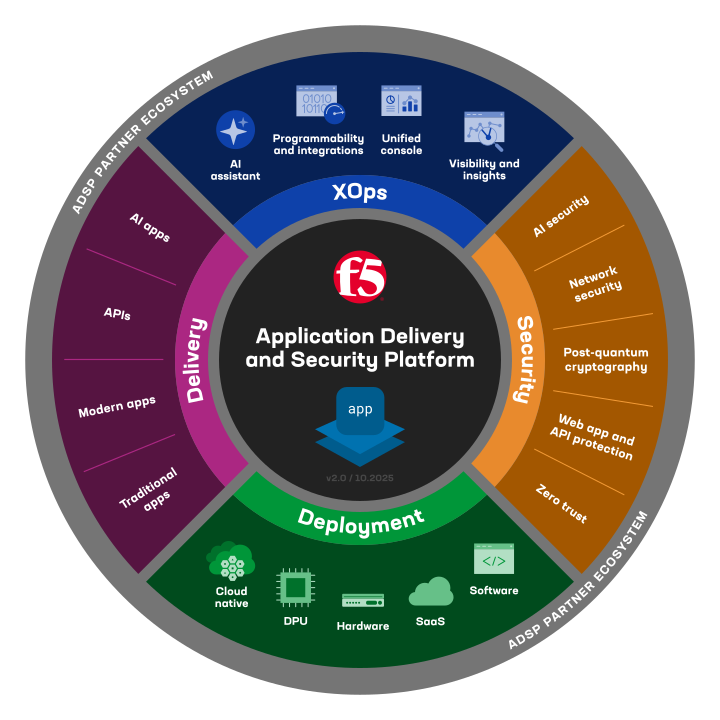
F5 ADSP brings together application delivery, multicloud networking, web app and API protection, DDoS and bot defense, and AI runtime security under policy-as-code with unified telemetry. By enabling XOps, F5 ADSP unifies observability, security beyond compliance, and crypto‑agility to form the blueprint for AI‑ready SaaS. The results are fewer blind spots, fewer brittle integrations, and more time spent on the features customers love.
The takeaway
Scaling SaaS is complex, fast‑moving, and too high‑stakes for manual, fragmented operations. Converged platforms like F5 ADSP reduce toil, accelerate time‑to‑market, and protect customer trust so your teams can focus on building the next game‑changing service while keeping crypto‑agility on the roadmap as post‑quantum readiness continues to be viewed as a top priority.
To learn more, read the O’Reilly report, Modernizing core infrastructure for AI-ready SaaS applications by Lee Atchison.
About the Author

Related Blog Posts
Secrets to scaling AI-ready, secure SaaS
Learn how secure SaaS scales with application delivery, security, observability, and XOps.
Optimizing AI pipelines by removing bottlenecks in modern workloads
As AI workloads scale, organizations are discovering slowdowns that come from the upstream data pipeline that feeds the AI model. Here's how F5 BIG-IP can help.
Why SASE and ADSP are complementary platforms
SASE secures the hybrid workforce and ADSP secures the hybrid application estate. Learn how these converged platforms differ and why they complement each other.
Fueling the AI data pipeline with F5 and S3-compatible storage
When S3-compatible storage is paired with F5 BIG-IP, organizations can ensure their AI data pipelines stay resilient, secure, and always flowing at peak performance.

How AI inference changes application delivery
Learn how AI inference reshapes application delivery by redefining performance, availability, and reliability, and why traditional approaches no longer suffice.
Why XOps is critical for the technology sector
XOps treats AI as a platform capability, integrating AI into infrastructure, security, and operational strategies to better support a company’s applications.